Planetary Lab – Interfaculty Program in Planetary Research
The Interfaculty Program in Planetary Research (IPPR) was established in 2019 to develop planetary science at the Jagiellonian University (JU), to enable the Jagiellonian University, to participate in future space mission, and strengthen the position of the Jagiellonian University in international structures related to planetary research.
We define planetary research as a part of space research, including:
Evolution of the Solar System: study of planets, moons, and small bodies
Sun’s influence on artificial and natural objects in space
The possibility of the formation, evolution or survival of living organisms beyond Earth
Earth exploration using space techniques
Social research on space exploration, including space law
The most important science targets for the JU have been identified as follows:
Mars
Small bodies in the Solar System
Moon
The main range of studies has been defined as:
Study of aeolian processes
Study of clay minerals
Studies of the subsurface layers of the celestial bodies
Sun impact on bodies in the Solar System
Meteorological and climatic research, including atmospheric physics
Development of digital image processing and analysis methods
Development of remote sensing methods and GIS techniques
Politics and law versus AI in space exploration
Settlement of disputes, including jurisdictional issues related to the exploration and exploitation of space
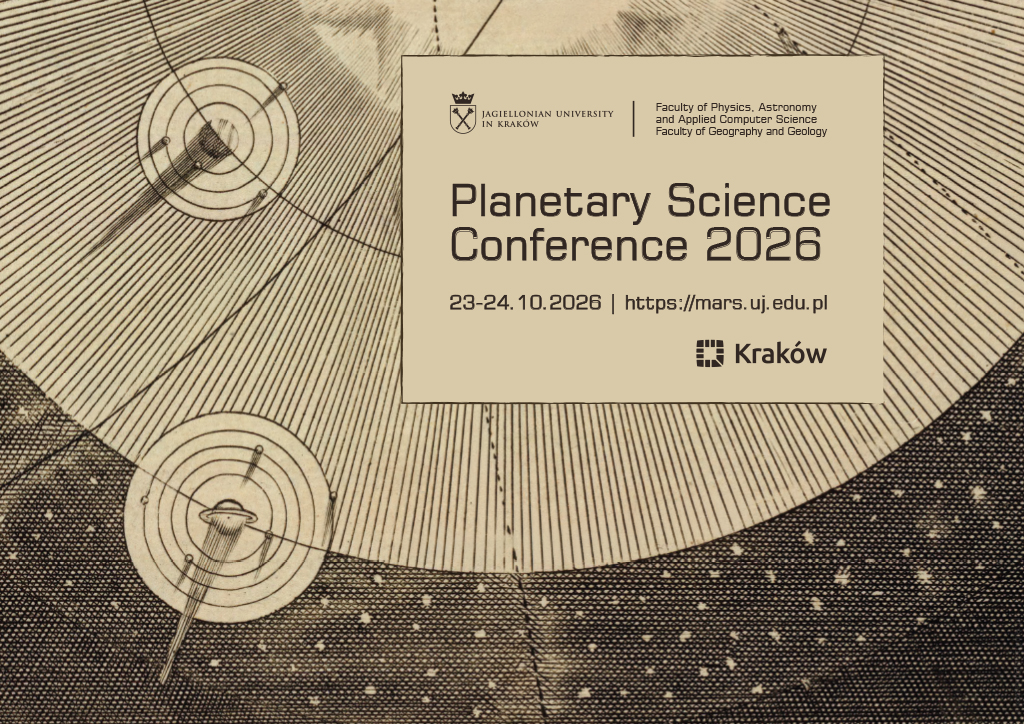
Planetary Science Conference 2026
The Planetary Science Conference 2026 will take place October 23-24 in Krakow as a hybrid event. Scientists and researchers from institutions in Poland and abroad are invited to participate.
The PSC 2026 consists of 3 parts: a scientific session (talks and posters), a field trip, and the Planetary Day (a public outreach event).
The official language of the scientific part of the conference is English.
Registration for the PSC2026 scientific sessions has closed, but you can still register for the Planetary Day lectures, please see below.
The PSC2026 schedule and book of abstracts are now available on the Indico platform: